


After Orbital: Codex as My Daily Driver
A follow-up to Orbital: Stay on top of meetings and tasks. When I introduced Orbital in 2024, Tana Outliner was my daily workspace. Today, Codex is my daily driver.
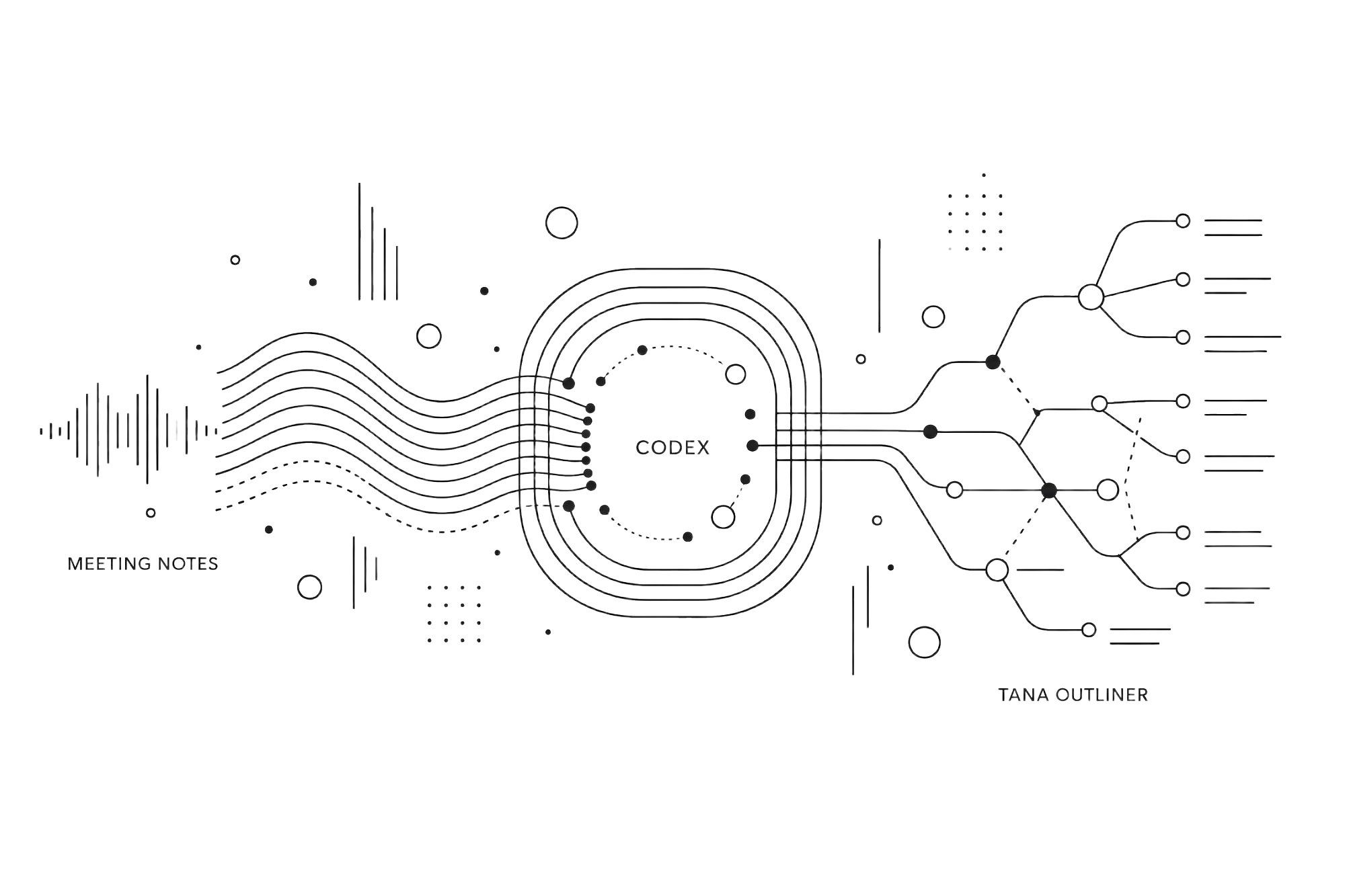
When I introduced Orbital in 2024, Tana Outliner was my daily workspace. It held my tasks, goals, meeting notes, and review rituals, and I spent much of my day working directly inside it.
That is no longer how I work.
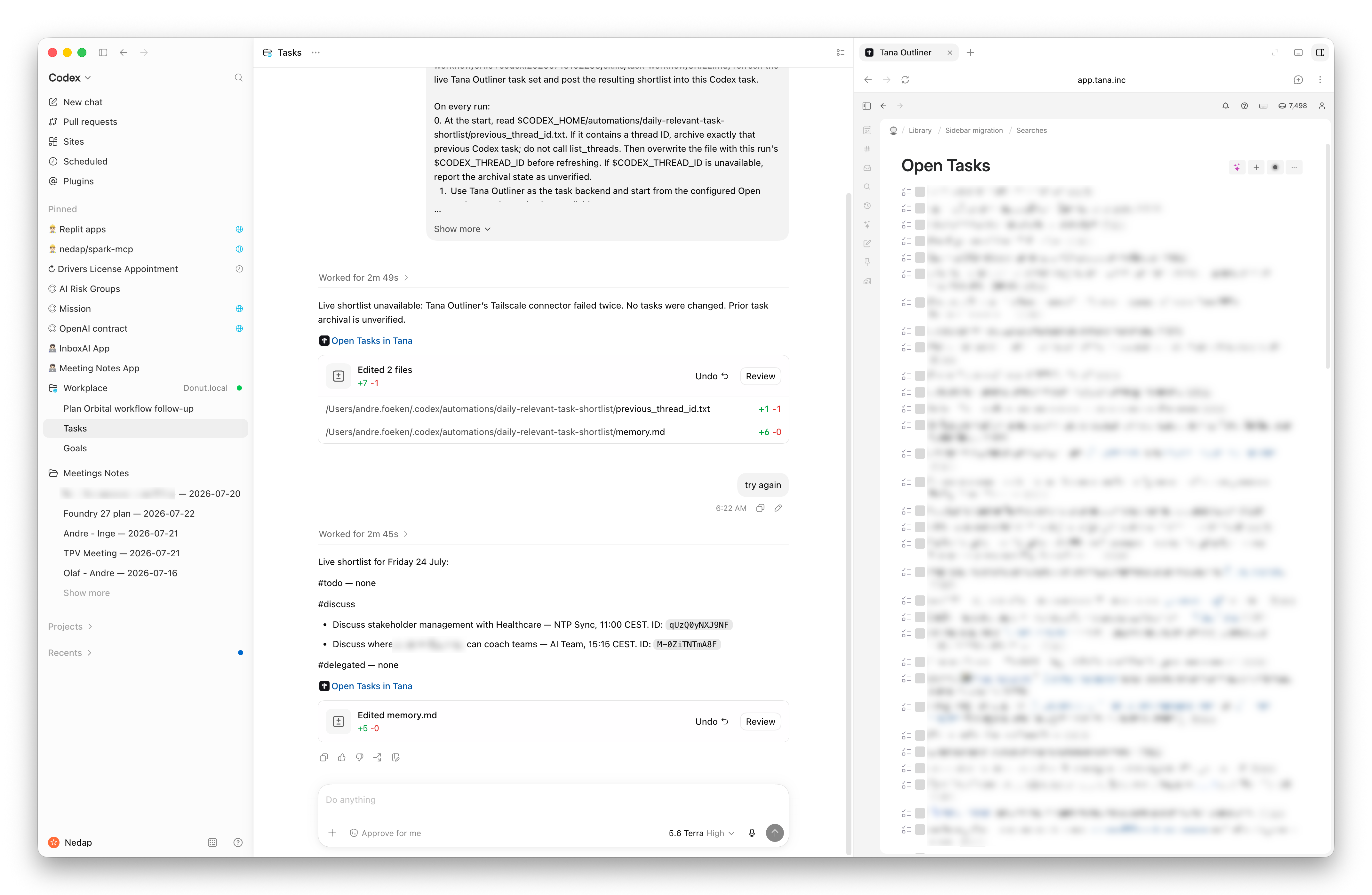
Today, Codex is my daily driver. Tana Outliner is still an essential part of my system, but it has moved into a side panel: it is the durable backend and visual representation for my tasks and goals, while Codex is where I mostly interact with the system conversationally and get my work done.
This is not a story about replacing Tana Outliner. I still use Tana Outliner when I am on the go, or whenever I want a visual interface to browse, organize, and manipulate the underlying information. The change is mainly about where I start and where I spend my time.
I have always tried to create systems where information came to me, at the right time and place. Tracking stuff is pointless if you have to remember to find it when needed. Tana Outliner's related content was a life saver when it first landed, and Codex turns this up another notch.
I recently read a post on x.com by Boris, the creator of Claude Code, that rung very true to me. As an engineer, I used to spend a lot of time tinkering and automating, trying to remove repetition and make things more efficient. I still do this now that I have moved most of my efforts to dealing with people and meetings. Orbital was the first generation of this, and I never stopped. Let's dive in.
Meetings: from taking notes to shaping my thoughts
The biggest change is how I work during meetings.
Before, I was taking manual notes in Tana Outliner and at the start of the meeting it helped me surface what I needed to discuss and find relevant tasks in the related content area.
Now, when a meeting starts, Codex provides me the same information pro-actively, and it has access to what is being said in the meeting live. I have created a small MacOS app called Meeting Notes that handles this. It uses realtime local transcription and creates a Codex thread per meeting for me. It is Open-Source and free.
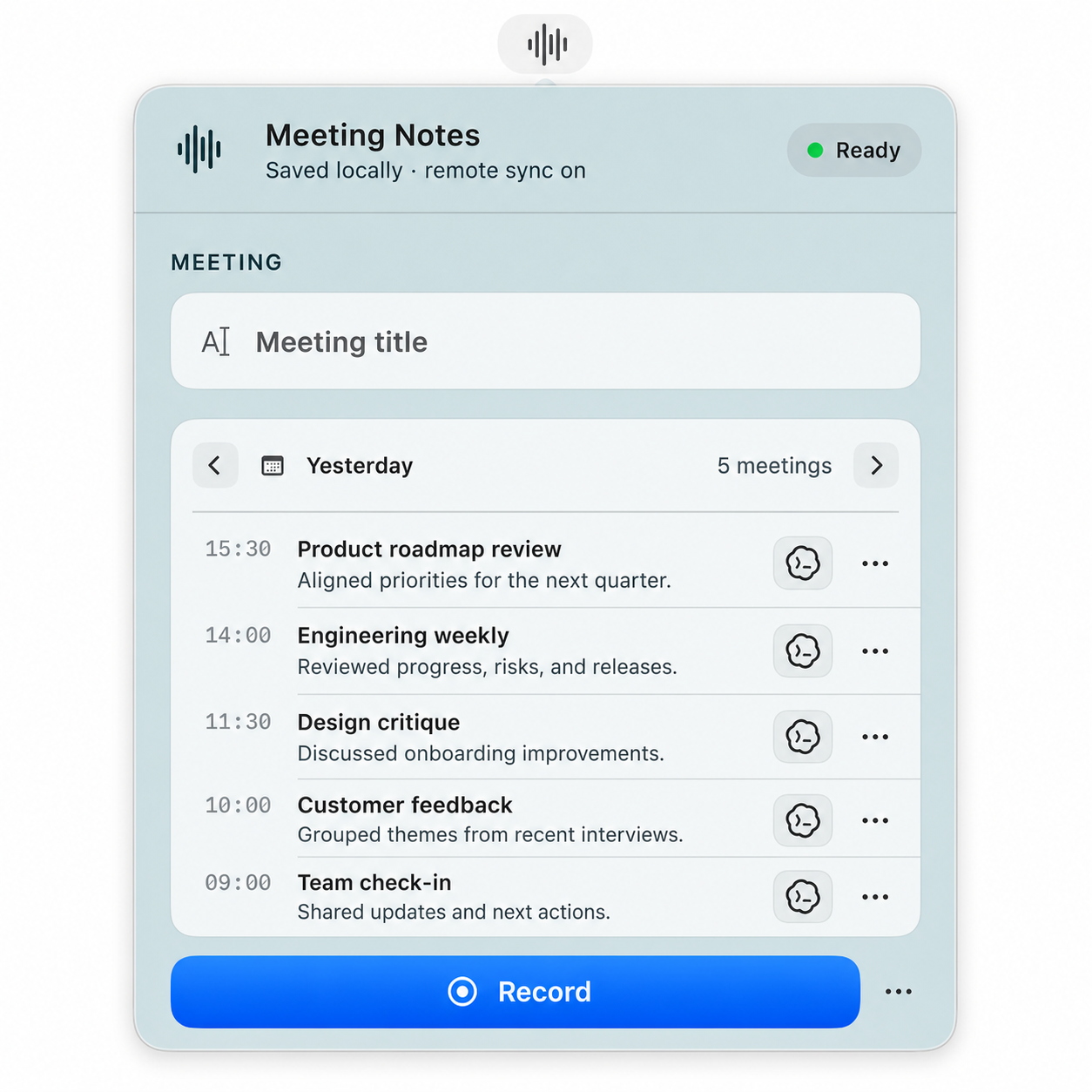
Previously, taking notes was how I stayed present. Now, I mostly rely on transcription through Meeting Notes. I still type during meetings, but for a different reason. I type to shape my thoughts, catch up to what was said, help me help the group stay on track, or turn something into action. When a concrete task emerges, I can still send it to Tana Outliner during the meeting similar to before.
The transcription captures what was said. My own writing captures what I think it means and what should happen next. After a meeting is finished, Codex provides longer-term retrieval across the meeting archive. But I notice I rarely use this.
Tana Outliner as the durable backend
Tana Outliner remains the structured foundation underneath this way of working. It holds my tasks and goals, gives them durable structure, and makes them available beyond a single Codex conversation, and in an easy to use on-the-go view.
Codex can help me capture, retrieve, interpret, and act on that information. Tana Outliner gives the resulting commitments somewhere stable to live.
What changed after Orbital
Orbital was built around the idea that a carefully designed workspace could support daily, weekly, and periodic loops. That principle still holds. What changed is that I no longer need to perform every part of those loops by navigating the workspace myself.
Codex now handles the loops for me. I have set up weekly and daily scheduled tasks that go through my goals and tasks. Every morning, I am greeted with a fresh Codex thread where I start the day. It has access to all my email, Slack, tasks, and goals. Many of the smaller, more repetitive tasks (like scheduling) Codex can handle fully on its own. For the bigger stuff, I spin off new threads to work with Codex on the task.
In the car to work, Codex and I work together using the live audio feature to handle all the basics. I especially love how it summarizes my x.com timeline so I can get a picture of what is happening in the world, and that we can tick off the first few tasks while on my way.
It is still so early, and it is obvious this is just the beginning, but it seems every week we get closer and closer to a full new way of working. I also see it at work around me. Many people at Nedap are starting to automate their tasks, and entire teams are delegating chunks of their work to AI. For us, the biggest unlock was finally being able to use the full breadth of connectors across the entire company. For a Publicly Traded European company of our size, this was a big compliance lift, but it was more than worth it.
On Tana (non Outliner)
Many of the workflows I just described can be done out of the box in the new Tana, but at work we have chosen to trust only our own OpenAI bubble with all of the data required for the full unlock of this. We are working with Tana on DPAs to broadly bring this to our employees too, as they intend to make these flows super easy to get started with. For me personally, I still love the flexibility and power of Tana Outliner, and combined with Codex, it is the perfect marriage.